

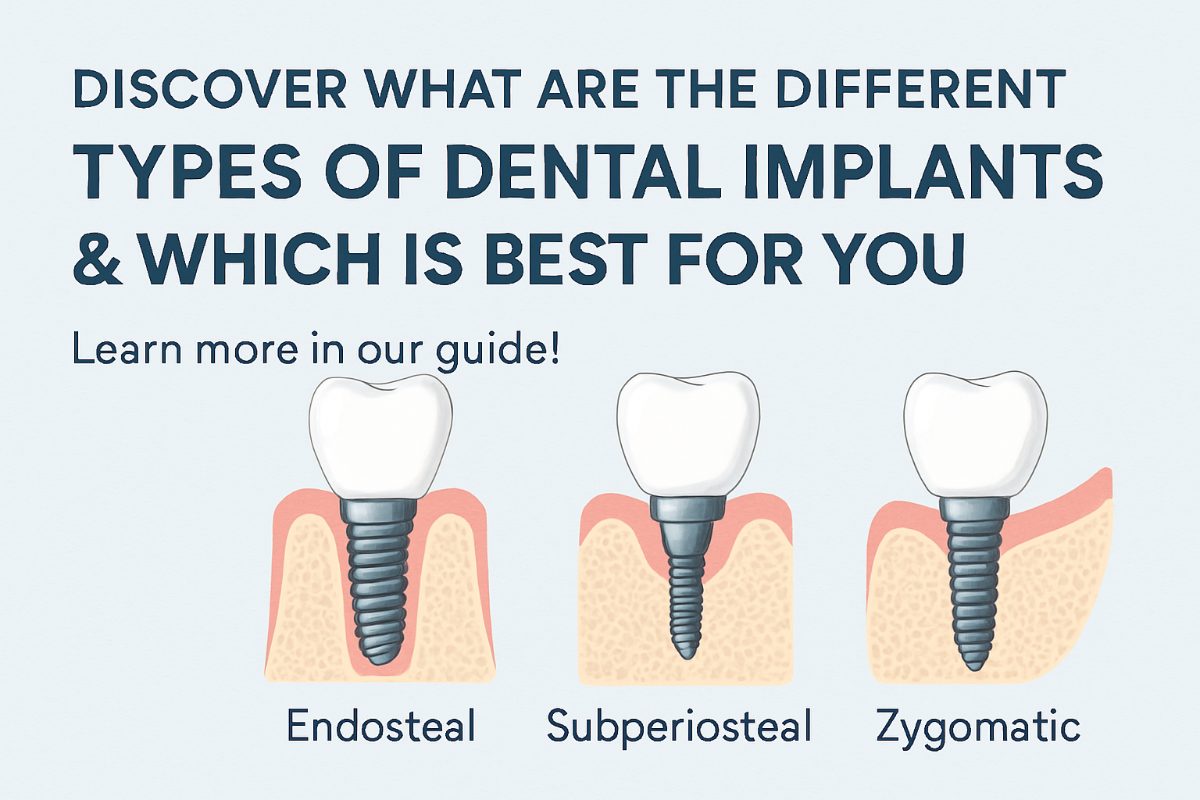
If you’re asking “what are the different types of dental implants,” the short answer is: there are several implant styles and full-arch systems designed for different bone levels, tooth needs, and patient goals. This guide compares the main implant types, who benefits from each, and how clinicians choose the right option.
It also explains materials, technology used in planning and placement, typical timelines, risks, costs, and questions to ask your implant dentist — including practical notes for patients in Cookeville, TN.
Quick Overview: What Is a Dental Implant?
A dental implant is a metal or ceramic post placed into the jaw to act like a tooth root. Implants support a prosthesis — an abutment plus a crown, bridge, or denture — to replace missing teeth. Unlike dentures that sit on gums, implants fuse with bone (osseointegration) to offer stable chewing, preserve bone, and provide a long-lasting foundation for restorations.
Types Of Dental Implants: The Main Categories
Endosteal (Root-Form) Implants
Endosteal implants are the most common. They look like screws and are usually titanium or zirconia. These are placed directly into the jawbone and can support single crowns, multi-tooth bridges, or implant-supported dentures. They work well when there is enough healthy bone and are the standard choice for many implant cases.
Subperiosteal Implants
Subperiosteal implants use a custom metal frame that sits on top of the jawbone but under the gum. This option is used when bone height is too low for standard implants, and the patient does not want or cannot have bone grafting. They are less common today but still useful in select cases.
Zygomatic Implants
Zygomatic implants are long implants anchored in the cheekbone (zygoma) instead of the upper jaw. They are an advanced solution for severe upper jaw bone loss when traditional implants or grafting aren’t feasible. Placement is more complex and typically done by specialists with experience in advanced implant surgery.
Mini Dental Implants (MDIs)
Mini dental implants are narrower than standard implants. They can stabilize a denture, serve as temporary supports, or be used in narrow spaces. MDIs are less invasive and may cost less, but they are not always suitable for large, long-term restorations where higher load and durability are needed.
All-on-4 / All-on-X and Full-Arch Solutions
All-on-4 and All-on-X use 4–6 implants to support a full-arch fixed prosthesis. This approach gives patients a fixed set of teeth faster and often avoids bone grafts by tilting posterior implants for better support. It’s a common pathway for people missing most or all teeth who want a stable, fixed restoration.
Implant-Supported Dentures vs Removable Overdentures
Implant-supported dentures can be fixed (screwed or cemented) or removable (overdentures that snap on to attachments). Fixed options feel more like natural teeth; removable overdentures are often easier to clean and may cost less. The choice depends on patient preference, hygiene ability, bone levels, and budget.
Materials: Titanium vs Zirconia
Titanium implants have a long track record for strength and bone integration. Zirconia implants are metal-free, more tooth-colored, and can offer better aesthetics for some patients. Both are biocompatible, but titanium remains the most commonly used for a wide range of cases. Zirconia may be chosen for metal sensitivity concerns or specific cosmetic goals.
How We Decide Which Implant Type Is Right
Bone Quantity & Quality
Adequate bone height and width matter. If the bone is thin or low, options include bone grafting, short implants, subperiosteal implants, or zygomatic implants for the upper jaw. The choice depends on how much bone is available, patient health, and whether they prefer grafting or alternative anchor methods.
Number & Location Of Missing Teeth
Single missing teeth are often treated with one endosteal implant and a crown. Multiple adjacent teeth can be replaced with implant-supported bridges. Full-arch loss often leads to All-on-4/All-on-X or multiple implants supporting a fixed bridge. The jaw (upper vs lower) and bite forces also guide implant number and placement.
Medical History & Lifestyle
Health factors like smoking, diabetes, certain medications, and oral hygiene affect implant healing and success. Smokers and uncontrolled diabetics have higher risk of complications. Your medical history helps dentists choose the safest implant approach and prepare any needed precautions.
Budget, Timeline, And Patient Goals
Cost, how quickly you want teeth, and aesthetic expectations influence choices. Mini implants or removable overdentures can be less expensive and faster, while full-arch fixed solutions and grafting increase cost and treatment time but often give the best long-term function and appearance.
Diagnosis & Planning: Modern Tech That Improves Outcomes
CBCT Scanning & 3D Imaging
Cone beam CT (CBCT) shows bone volume, nerve positions, and sinus locations in 3D. This imaging helps avoid nerves, plan implant size and position, and choose when grafting or zygomatic implants are needed. CBCT reduces surprises during surgery and improves safety.
Digital Impressions & Primescan
Intraoral scanners like Primescan capture precise digital impressions for crowns, bridges, and dentures. Digital scans improve fit, reduce remakes, and speed up the restorative process compared with traditional impressions.
3D Printing & Surgical Guides
3D-printed surgical guides translate a digital plan into accurate implant placement during surgery. Guides improve precision, shorten surgery time, and reduce the risk of misplacement — especially helpful for complex cases and full-arch restorations.
Same-Day Restorations (CEREC) & In-House Lab Advantages
CEREC and in-house labs let practices fabricate crowns, bridges, and some prostheses quickly, sometimes the same day. In-house production often lowers costs, speeds turnaround, and lets the clinical team control quality and customization more tightly.
Procedure Steps & What Patients Can Expect
Typical steps include a consultation with imaging and planning, surgical placement of the implant post, a healing period for osseointegration (often 3–6 months), and later placement of an abutment and final restoration. Some cases allow immediate loading (temporary crown or bridge, same day), while others need staged healing. Follow-up visits check healing and prosthetic fit.
Risks, Success Rates, And Longevity
Risks include infection, implant failure, nerve injury, sinus issues, and prosthetic problems. With good planning and care, success rates are generally high — often above 90–95% over many years. Longevity depends on maintenance, oral hygiene, smoking status, and overall health; well-maintained implants can last decades.
Cost, Insurance, And Financing Options
Costs vary widely by implant type, number of implants, need for grafting, and whether you choose fixed or removable restorations. Some dental insurance covers parts of the restoration but rarely covers full implant costs. Many practices offer third-party financing, in-house payment plans, or membership plans to spread costs. Ask your provider for an itemized estimate.
Questions To Ask Your Implant Dentist
– How many cases of each implant type have you placed? – Do you use CBCT and digital surgical guides? – What is your complication and success rate with these treatments? – Who will do the restorative work — you or another dentist? – What sedation options do you offer? – Do you have an in-house lab and can you provide a timeline and cost estimate?
About Golden Oak Sedation Dental & Implant Center and Dr. Johnny Shanks
Golden Oak Sedation Dental & Implant Center offers implant and sedation dentistry in Cookeville, TN. Dr. Johnny Shanks, DDS, trained at the University of Tennessee and advanced programs like the Kois Center, focuses on implant and restorative solutions with patient comfort in mind. The practice uses CBCT, Primescan, 3D printing, CEREC, and an in-house lab to plan efficient, precise care and to offer sedation options for anxious patients.
When To Schedule A Consultation
Schedule an implant consult if you have missing teeth, loose dentures, or trouble chewing. Bring medical history, any recent dental x-rays, a list of current medications, and questions about goals and budget. Early planning can identify the simplest and most durable solution for your mouth.
FAQ
– How long does healing take? Typical osseointegration takes 3–6 months; immediate-loading cases vary. – Is there an age limit for implants? No strict age limit; overall health and bone condition matter more than age. – Will it hurt? Local anesthesia, sedation options, and modern techniques keep discomfort low; most patients report manageable pain. – What if I need bone grafting? Grafting adds time and cost but can create the foundation for standard implants. Alternatives like zygomatic implants or subperiosteal frames exist for severe bone loss. – How long do implants last? With good care, implants often last decades; crowns and prostheses may need replacement over time.
Call To Action
If you’re still wondering “what are the different types of dental implants in Cookeville, TN,” or which option fits you best, request a consultation to review your images and treatment choices. We can discuss costs, financing, and sedation to make care comfortable and clear.